
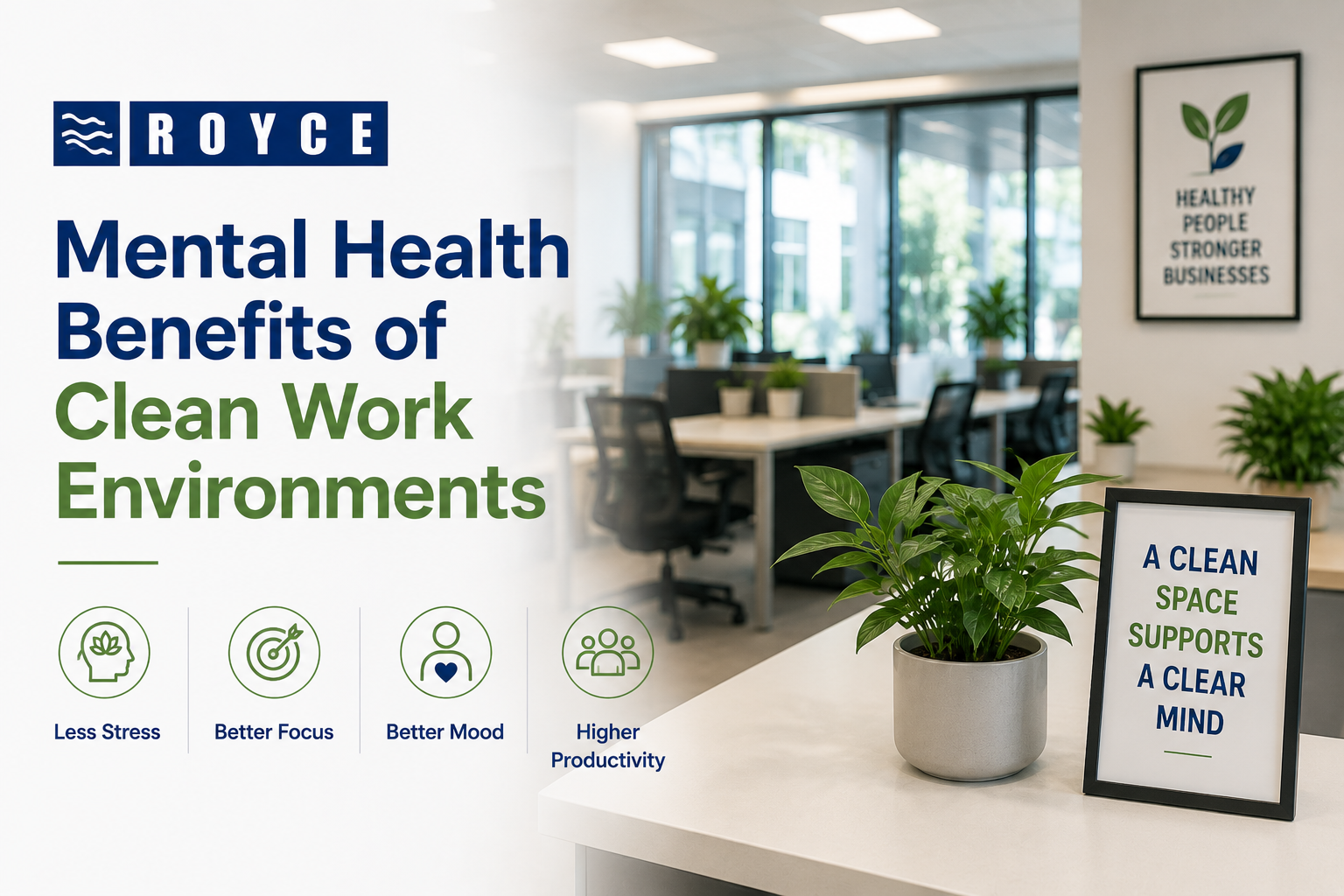
Workplace mental health has moved from the margins of HR conversation to the centre of it. Australian employers are increasingly aware of their obligations under work health and safety legislation to address psychological as well as physical hazards, and of the genuine business case for supporting employee wellbeing. What is less often part of this conversation is the contribution of the physical environment, and specifically cleanliness, to mental health outcomes at work.
The connection between clean environments and psychological wellbeing is not marketing language. It is supported by research in environmental psychology, behavioural science, and workplace health that consistently finds meaningful links between how a space looks and feels and how the people in it think, feel, and perform. This article covers what that research indicates, why the mechanisms make intuitive sense, and what it means practically for Sydney businesses thinking about their commercial cleaning approach.
|
Professional Office Cleaning Across Sydney Royce Cleaning provides commercial cleaning for offices, warehouses, strata, and facilities of all types across NSW. ISO certified since 1996. |
The Research Picture: What Studies Tell Us
Researchers in environmental psychology have studied the relationship between physical environment and psychological state across many settings. The consistent finding is that people are sensitive to the state of the spaces they inhabit, often without consciously registering what is affecting them. Several themes emerge repeatedly:
- Cluttered and disordered spaces are associated with elevated cortisol levels (the stress hormone) in the people who occupy them. Studies involving residential environments have found that people with more ‘cluttered’ home spaces report higher stress and difficulty unwinding. Similar effects have been observed in workplace settings
- Visual noise competes for cognitive resources. The brain processes the surrounding environment continuously, even when a person is focused on a task. A cluttered, dirty, or visually disordered workspace creates more low-level processing demand, reducing the attentional resources available for the primary task
- Clean environments are associated with feelings of competence and control. Research on environmental mastery suggests that maintaining order in the surrounding space supports a sense of agency, and environments that are obviously well-maintained signal care and competence on the part of the organisation
- Malodour in work environments is consistently associated with negative mood effects. Cleaning that removes odour-causing bacteria, mould, and accumulated organic material produces measurable improvements in subjective wellbeing among occupants
These are not uniform findings across all studies, and the field is not without complexity. But the general direction of the evidence supports the position that cleanliness is not merely a comfort factor but a genuine contributor to psychological functioning at work.
Stress, Focus, and Cognitive Load
The relationship between environmental disorder and cognitive performance is one of the more practically relevant findings for workplace managers. The concept of cognitive load, the total mental effort being used at any given time, is a useful lens for understanding why a cluttered or dirty environment affects performance.
Every visual element that the brain processes uses some portion of available cognitive resources. A workspace filled with disorder, dust, dirty surfaces, or accumulated clutter imposes a background processing cost that a clean, organised space does not. Over a full working day, this background cost accumulates.
This is not a theoretical concern. Employees who describe their workspace as ‘chaotic’ or ‘messy’ consistently report more difficulty concentrating and higher levels of end-of-day mental fatigue than those who describe their workspace as ordered and clean. For businesses with knowledge workers whose output depends on sustained attention and clear thinking, the quality of the office cleaning service is a genuine productivity variable.
Morale and Organisational Signals
The cleanliness of a workplace sends a signal to the people who work in it. When an organisation maintains a genuinely clean, well-presented environment, it communicates something to its employees: that their comfort and wellbeing are valued, that standards are maintained, and that the organisation is functional and cared for. These signals are absorbed by employees, often without conscious awareness.
Conversely, a visibly dirty or neglected workplace communicates the opposite. Smudged glass, stained carpets, dirty bathrooms, and overflowing waste bins tell employees that maintenance is not a priority. This can contribute to a sense of being undervalued, which research in organisational psychology links to reduced engagement, lower morale, and higher turnover intention.
For shared spaces like strata buildings or industrial facilities, the same principle applies to a broader community of occupants. Strata cleaning services and warehouse cleaning both serve this morale and perception function in addition to their practical hygiene role.
| 💡 The bathroom test: The state of a workplace bathroom is one of the strongest predictors of how employees feel about the organisation’s standards and care. Employees routinely cite bathroom cleanliness as a significant factor in their overall workplace satisfaction. If the bathrooms are an afterthought in the cleaning schedule, employees notice. |
Allergens, Air Quality, and Mental Clarity
Indoor air quality has direct links to cognitive performance and psychological wellbeing. Environments with high allergen loads (dust mites, mould spores, pollen accumulation) create physical symptoms including fatigue, headache, and difficulty concentrating that are often attributed to other causes. The same is true of environments with poor air quality from off-gassing carpets, volatile organic compounds from cleaning products, or inadequate ventilation of stale air.
Professional carpet cleaning reduces the embedded allergen load that routine vacuuming cannot address. Regular cleaning of HVAC supply vents and the use of low-VOC cleaning products both support the air quality dimension of workplace mental health. These are not small details. Employees who are managing allergy symptoms, breathing compromised air, or experiencing headaches from chemical off-gassing are not functioning at their cognitive or emotional best.
After-Hours Cleaning and the Morning Environment
The timing of commercial cleaning matters more than most employers consider. Offices that are cleaned overnight and ventilated before staff arrive in the morning offer a qualitatively different start-of-day experience from those where cleaning happens during the working day (creating disruption and chemical smell exposure) or not at all.
Walking into a clean, fresh, well-ordered office at the start of a workday has a measurable positive effect on mood and on the subjective sense of readiness to work. This ‘fresh start’ effect is well documented in behavioural economics research, where new beginnings are associated with increased motivation and goal-directed behaviour.
Royce Cleaning provides after-hours cleaning schedules precisely to deliver this morning-environment quality. The about us page details the approach to quality commercial cleaning that has defined the service since 1996.
Practical Implications for Employers
For employers and facilities managers thinking about workplace wellbeing, the research on clean environments suggests several practical implications:
- The cleaning budget is not simply an operational overhead. It is a contribution to employee wellbeing and cognitive performance that belongs in the conversation about workplace mental health investment
- The frequency and timing of cleaning matter. A workspace that is cleaned daily and aired before staff arrive provides different mental health benefits from one cleaned weekly or during working hours
- Bathrooms and kitchen areas deserve disproportionate attention in the cleaning schedule. These are the spaces where cleanliness is most viscerally noticed by employees and where the symbolic message of organisational care is most directly read
- Carpet cleaning, window cleaning, and deep cleaning schedules are not aesthetic luxuries. They address the accumulated environmental burdens that baseline daily cleaning does not remove
- Engaging a professional commercial cleaning service with documented quality standards, like Royce Cleaning’s ISO-certified service, gives employers confidence in the consistency of the clean rather than relying on variable ad hoc arrangements
|
Invest in Your Team’s Wellbeing Through a Cleaner Workplace Royce Cleaning provides reliable, professional commercial cleaning across Sydney and NSW. Available 365 days a year. ISO certified. |
Frequently Asked Questions
Does research actually support a link between clean workplaces and mental health?
Yes, in the general direction. Environmental psychology research consistently finds associations between physical environment order and psychological outcomes including stress levels, cognitive performance, and mood. The relationship is not simple or deterministic, but it is well-supported enough that it merits serious consideration by employers investing in workplace wellbeing. Workplace cleanliness is one of the more cost-effective environmental interventions available.
How does workplace cleanliness relate to employer WHS obligations?
Under the Work Health and Safety Act 2011 (NSW and national harmonised legislation), employers have a duty to provide a safe workplace that addresses both physical and psychological hazards. A workplace that is poorly maintained, has compromised air quality, or generates avoidable stress through visual disorder or odour may fall below the standard required under WHS obligations. Maintaining clean and well-presented workplaces is one practical component of meeting this duty.
What is the most impactful single improvement a Sydney business can make to its workplace cleanliness?
Moving from infrequent or inconsistent cleaning to a scheduled daily professional clean produces the most consistent improvement in the quality of the workplace environment. The shift from a reactive to a proactive cleaning model, where cleaning happens before problems become visible rather than after, dramatically changes the baseline environment that employees experience. Contact Royce Cleaning to discuss a scheduled commercial cleaning programme suited to your Sydney facility.