
A retail cleaning strategy that works has three layers. Staff handle spills, bins and quick touch-ups during trading hours. A professional clean happens before opening or after close, when floors can be wet-cleaned safely and every area can be reached. And a periodical program takes care of the work that protects the store over time, such as floor restoration, high dusting and glass. The effort goes where customers form an impression first (the shopfront, entry, sales floor, counters, fitting rooms and toilets), while back-of-house areas are kept safe, uncluttered and free of pests.
This guide is for store managers, retail operations managers and shopping centre tenants in Sydney who want a cleaning arrangement that fits around trade instead of fighting it.
What should a retail cleaning schedule cover?
The most common problem with retail cleaning is not a lack of effort. It is that everything is treated as the same kind of task, so the important work competes with the urgent work and loses. Splitting the schedule into layers fixes that.
During trading hours
These are the tasks that cannot wait for close. Spills on the sales floor, a dropped drink at the entry, overflowing bins, fingerprints on the front door glass, and fitting rooms that need resetting between customers. They are usually handled by store staff, with a simple spill kit and clear instructions on what to do and who does it. The goal during trade is safety and presentation, not deep cleaning.
The daily professional clean
This is the main clean, done outside trading hours by a cleaning contractor or a dedicated cleaner. It covers floors (vacuuming, mopping or machine scrubbing depending on the surface), counters and service areas, fixtures and display surfaces within reach, glass and mirrors, toilets and staff amenities, staff rooms, bins and waste, and the stockroom floor. It is the clean that resets the store for the next day’s trade.
The periodical program
These are the tasks done weekly, monthly, quarterly or annually: strip and seal of vinyl floors, maintenance of polished concrete, carpet extraction, high dusting of ceilings, vents and lighting, cleaning behind and under fixtures, external glass and shopfront signage, and a deeper clean of stockrooms and loading areas. The periodical program is what stops a store from slowly looking older than it is. It is also the layer that tends to be cut first, which is why it belongs in the written scope with a frequency attached.
When should a retail store be cleaned: before opening or after close?
Both work. The right answer depends on the store, the building and the trading pattern.
After close is the most common choice. The store is empty, floors have overnight to dry, and the cleaner can work without interruption. The trade-offs are security and access: the cleaner needs keys or access cards, alarm codes, and a clear process for locking up and setting the alarm, and shopping centres usually have their own after-hours access rules for contractors.
Before opening suits stores that trade late, or where the morning team wants to start in a freshly cleaned space. The window is often tighter, so the scope needs to be realistic about what can be done in the time, and wet floors need to be dry before the doors open.
Some stores split the work: the heavy floor cleaning after close, and a light reset of glass, counters and toilets before opening. Whatever you choose, the timing should be written into the scope so it does not drift.
If your store is in a shopping centre, check your lease and the centre’s contractor rules before you set a schedule. Centre management typically looks after the common areas, while the tenant is responsible for the tenancy itself, and many centres require contractors to be inducted, to sign in, and to use the loading dock at particular times.
Which areas of a store deserve the most attention?
Entrances and shopfronts
The entry is the first thing a customer sees and the place where most dirt comes into the store. Clean door glass, a clear threshold and entry matting that actually traps grit all matter. Matting does most of its work in wet weather, so it is worth checking that there is enough of it and that it is cleaned or swapped often enough to stay effective. Door tracks and the base of the shopfront collect debris that is easy to miss and obvious once noticed.
The sales floor
Retail floors come in many finishes, and each has its own routine. Vinyl and other resilient floors need their protective finish maintained, with periodical strip and seal before the old coat breaks down. Tiles need grout kept clean. Carpet needs regular vacuuming and periodical extraction in the traffic lanes. Polished concrete has become common in retail fit-outs, and it stays looking good with the right maintenance; when it needs restoring, concrete grinding and polishing can bring it back. Fixtures, shelving and display surfaces should be dusted within reach daily, with higher surfaces on the periodical program.
Fitting rooms
Fitting rooms are small spaces with a lot of contact. Mirrors, hooks, seats, curtains or doors, light switches and the floor all need attention, and forgotten items such as tags, pins and hangers should be cleared at every clean. A tired fitting room undermines the product hanging in it.
Counters, payment terminals and high-touch points
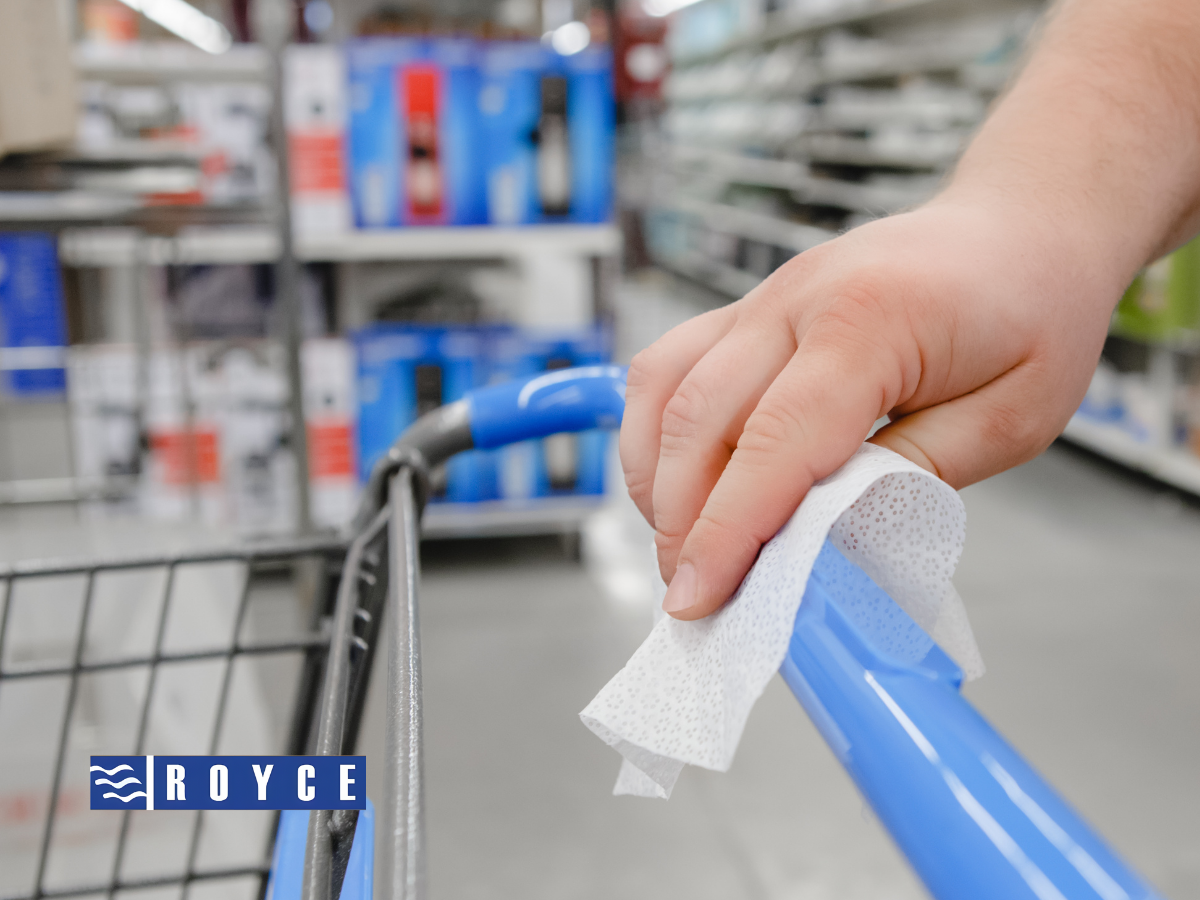
Counters, payment terminals, door handles, trolley and basket handles, and handrails are touched constantly. They should be cleaned at every professional clean, and wiped during trade as needed. Payment terminals, screens and other electronics need care: follow the manufacturer’s guidance on what can be used, and never spray liquid directly onto the device.
Customer and staff toilets
Toilets that are clean, stocked and odour-free are noticed far less than toilets that are not. Consumables such as soap, paper towel and toilet paper, sanitary disposal units and air fresheners are part of the picture as well as the cleaning itself. Royce’s workplace hygiene services cover the supply and servicing side, and our article on workplace washroom and hygiene requirements in NSW explains the obligations behind them.
Stockrooms, loading areas and staff rooms
Back of house rarely gets the attention the sales floor does, but it is where trip hazards, pests and waste problems start. Cardboard, packaging, pallets and returns accumulate quickly. A clear stockroom floor, cleared walkways, a clean staff kitchen and a waste area that is emptied and washed regularly all reduce risk. Where waste volume is significant, a planned commercial waste removal service is usually more efficient than relying on general bins, and keeping food scraps and packaging under control is the first line of pest prevention.
How do you keep floors safe during trading hours?
Under section 19 of the Work Health and Safety Act 2011 (NSW), a person conducting a business or undertaking must ensure, so far as is reasonably practicable, the health and safety of workers and of other people affected by the business. In a store, other people means customers. Slips on wet or contaminated floors are one of the most foreseeable risks a retailer has.
The practical controls are straightforward:
- Do the wet cleaning outside trading hours. Machine scrubbing and full mopping belong in the after-close or pre-opening clean, not in the middle of trade.
- Deal with spills immediately. Keep a spill kit somewhere staff can reach quickly, and make it clear who responds.
- Use signage while a floor is wet, and remove it once the floor is dry, so customers learn that a sign means something.
- Manage wet weather at the entry. Extra matting and more frequent checks of the entry floor on rainy days.
- Keep walkways clear of stock, cartons and cleaning equipment.
Cleaning chemicals also come under WHS. Under the Work Health and Safety Regulation 2017 (NSW), hazardous chemicals must have current Safety Data Sheets available and must be stored and handled correctly. Ask your cleaning contractor which products they use in your store and where they are kept.
How should cleaning change around peak trading, stocktakes and refits?
Retail trade is seasonal, and the cleaning program should be too. A schedule that works in a quiet month can fall apart in the weeks before Christmas or during a major sale.
Before peak periods, bring the periodical work forward. Strip and seal the floors, extract the carpets, clean the high fixtures and the shopfront glass before the busy weeks begin, not in the middle of them. During peak trade itself there is rarely the time or the access to do that kind of work, and the extra foot traffic will show up every gap. Our pre-holiday commercial cleaning guide covers the timing in more detail.
During peak periods, expect more of everything: more spills, more packaging, more waste, more use of the toilets and fitting rooms. It is worth agreeing in advance on extra bin runs, more frequent toilet servicing and, where the store trades late, whether the daily clean needs more time.
Around stocktakes, a clean before the count makes the work faster and a clean after it deals with the dust and disruption that moving stock creates. Stockrooms in particular benefit from a deeper clean while shelves are being emptied and checked.
For refits and new store openings, builders’ cleaning is a separate job from the daily clean. Construction dust settles on every surface, including inside light fittings and vents, and it will keep reappearing for weeks if it is not removed properly before the store opens. Plan for a post-construction clean between handover and fit-out of stock, and a final detail clean before the doors open.
How does cleaning differ across types of retail?
The framework is the same everywhere, but the emphasis changes with the store.
- Fashion and apparel: fabric dust on fixtures and in vents, fitting rooms, mirrors and a lot of glass.
- Homewares and gifts: many small display surfaces and fragile stock, which make dusting slower and more careful.
- Health, beauty and pharmacy retail: a higher expectation of hygiene at counters, testers and consultation areas.
- Large format and hardware: big floor areas that are more like warehouse floors, cleaned with ride-on or walk-behind scrubbers, plus loading docks and outdoor areas.
- Food retail: any store that handles unpackaged food has obligations under the Food Standards Code on top of everything above. If that applies to you, read our guide to cleaning protocols for commercial kitchens.
What should you ask a retail cleaning contractor before signing?
A low quote is not a scope of works. Before you sign, it is worth asking:
- Will you do a site walk through? A contractor who quotes a store without seeing it is guessing.
- What exactly is in the scope? Ask for the daily tasks and the periodical program in writing, with frequencies.
- How will after-hours access work? Keys, alarm codes, sign-in rules, what happens if a cleaner is running late or the alarm is triggered.
- Are your cleaners inducted for this site? Particularly in shopping centres, where the centre has its own rules.
- Who supplies the consumables and equipment? And who supplies the toilet and hygiene consumables.
- How are missed or unsatisfactory cleans handled? There should be a clear process and a named contact.
- Can you also handle waste, pest prevention and periodical floor work? One provider for all of these is simpler to manage.
Our articles on building a cleaning scope of work and auditing your current cleaning contractor go into more detail.
Frequently asked questions
Who is responsible for cleaning shopping centre common areas?
In most shopping centres, centre management arranges cleaning of the malls, food courts, amenities and car parks, and the tenant is responsible for cleaning inside its own tenancy. The exact split is set out in your lease, so check it before you set up your own cleaning schedule.
Can a store be cleaned while it is trading?
Light tasks such as spot cleaning, emptying bins, wiping counters and resetting fitting rooms can be done during trade. Wet floor cleaning, machine scrubbing and anything that blocks aisles should be done outside trading hours to keep customers and staff safe.
How often should retail floors be stripped and sealed?
It depends on the floor, the foot traffic and how well the daily cleaning protects the finish. A busy entry and main aisle will need attention more often than a quiet corner of the store. The practical approach is to set a periodical frequency in the scope and adjust it based on the condition of the floor at each review.
Can one cleaning contractor look after several stores?
Yes, and for retailers with more than one location it often makes sense. One contract, one standard and one point of contact make it easier to keep every store presenting the same way. Our guide to cleaning logistics for multi-site businesses explains how to set that up.
Get a retail cleaning scope that fits your trading hours
Royce Cleaning provides retail cleaning across Sydney as part of our commercial cleaning services, with daily cleans scheduled around your trading hours and periodical work planned in advance. Request a quote and we will walk through your store with you, look at the floors, fittings and back-of-house areas, and put together a scope of works that suits how you trade.
Sources: Work Health and Safety Act 2011 (NSW), section 19; Work Health and Safety Regulation 2017 (NSW).