
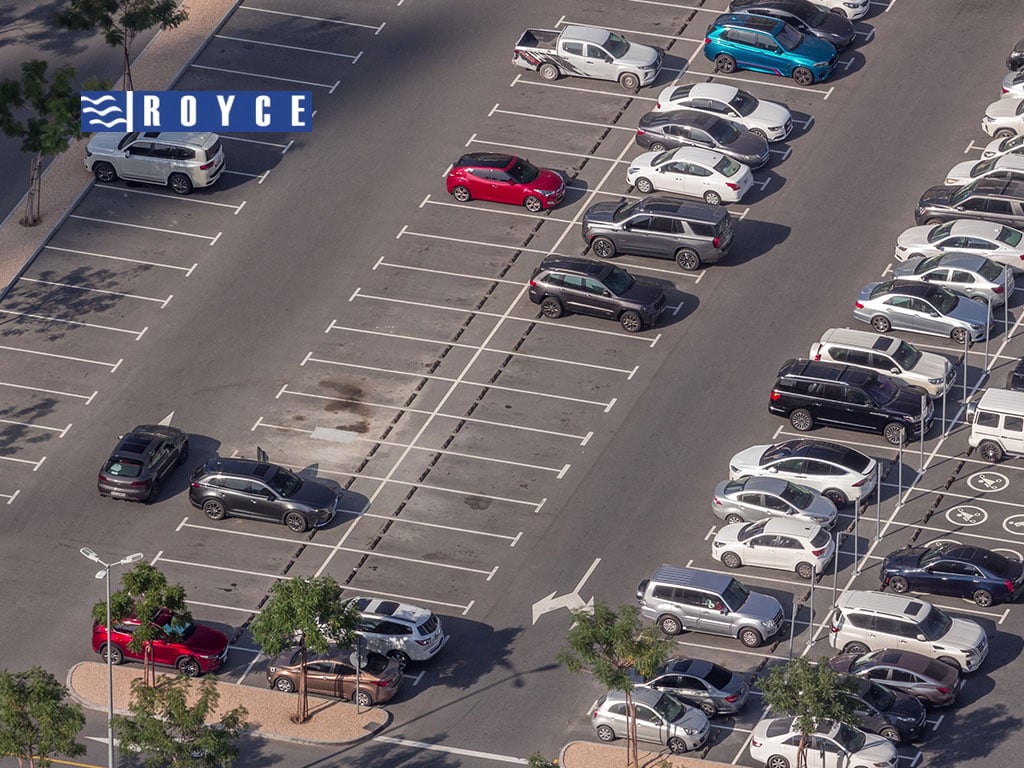
Car park line marking tells drivers and pedestrians where to go: parking bays, aisles and traffic direction, pedestrian crossings and walkways, accessible parking, loading zones and no-parking areas. Off-street car parks in Australia are designed to the AS 2890 series of standards, principally AS/NZS 2890.1:2004 for general car parking and AS 2890.6:2022 for parking for people with disabilities. Once a car park is built, the practical job for the owner or manager is keeping those markings visible and accurate. Faded bays, worn crossings and missing arrows are a safety problem first and a presentation problem second.
This guide is for facilities managers, property managers, strata committees and business owners in Sydney responsible for an off-street car park, whether that is a basement under a strata building, a customer car park at a retail or medical site, or the yard and loading area of a warehouse.
Which standards apply to car park line marking?
The design of off-street car parks in Australia is governed by the AS 2890 Parking facilities series:
- AS/NZS 2890.1:2004, Off-street car parking. Sets minimum requirements for the design and layout of off-street car parks, including multi-storey car parks, covering things like bay dimensions, aisles, access driveways and signage.
- AS 2890.6:2022, Off-street parking for people with disabilities. Sets the requirements for accessible parking spaces, including their dimensions, the shared area beside them, line marking and the symbol of access. It replaced the earlier 2009 edition.
- AS 2890.2:2018, Off-street commercial vehicle facilities. Covers loading docks and areas used by trucks and other commercial vehicles.
These standards are design standards. They are typically applied when a car park is built or substantially altered, often through the building approval and development consent process. For an existing car park, the main obligations in practice are to keep the approved layout clearly marked and to make sure it remains safe for the people using it.
That distinction matters. Repainting an existing layout is maintenance. Changing the layout, such as moving bays, changing the number of spaces or relocating accessible parking, may have consequences for your development consent or building approval, and should be designed and checked before any paint goes down.
What should car park line marking include?
A well-marked car park answers every question a driver or pedestrian might have without them needing to stop and think. Typically that includes:
- Parking bays, clearly defined so cars park where the layout intends.
- Aisles and directional arrows, especially in one-way systems and at ramps.
- Pedestrian crossings and walkways, so people walking to lifts, stairs and entrances have a defined path.
- Accessible parking bays and their shared areas, marked to the applicable standard.
- Loading zones, no-parking and hatched areas, including areas that must stay clear for fire services, bin collection or deliveries.
- Hazards and fixed obstacles. Kerbs, columns, bollards, speed humps, wheel stops and the edges of ramps are often highlighted so they are easier to see.
- Stair treads and safety barriers. Highlighting stair nosings, handrails and barriers helps people see changes in level, particularly in dim basements.
Royce’s line marking service covers car park bays, directional markings and accessible parking, along with highlighting safety barriers, handrails and stair treads.
How should accessible parking be maintained?
Accessible parking spaces have specific requirements under AS 2890.6:2022, covering the size of the bay, the shared area beside it, the line marking and the symbol of access. The number of accessible spaces a site must provide is set through the building approval process when the car park is built or altered.
For an existing car park, the rules of thumb are straightforward:
- Repaint accessible bays exactly as they are laid out, unless a designer has confirmed a change.
- Keep the shared area clear and marked. The shared area beside an accessible bay is part of the space, not a spare patch of concrete.
- Do not relocate or remove accessible bays as part of a repaint. That is a design change, not maintenance.
- Check older layouts if you are reworking the car park. The 2022 edition of AS 2890.6 replaced the 2009 edition, so a substantial rework is a good time to have the accessible parking checked against the current standard.
How often should car park line marking be repainted?
There is no single interval. How long markings last depends on how much traffic the car park carries, how vehicles move across the markings (turning tyres wear paint much faster than straight-line traffic), the surface underneath, the marking product used, and whether the car park is exposed to sun and rain or protected in a basement.
The better approach is to inspect rather than wait for a date. Walk the car park and look for:
- bay lines that are faded or broken, particularly at the entry end of each bay where tyres turn,
- arrows and crossings that are hard to read in poor light,
- markings that disappear when the surface is wet,
- markings that no longer match how the car park is actually used,
- old layouts showing through newer ones, which confuses drivers.
High-wear areas such as entries, ramps and the bays nearest the lifts often need repainting more often than the rest of the car park. Spot repainting those areas can extend the time between full repaints.
What about warehouse and loading dock line marking?
Inside warehouses and around loading docks, line marking does a different job. It separates people from forklifts and other powered mobile plant.
Safe Work Australia’s traffic management guidance for warehousing recommends defining the areas where powered mobile plant operates as pedestrian exclusion zones, and keeping powered mobile plant out of pedestrian walkways and work areas. Clearly marked walkways, crossings, exclusion zones and loading areas are a core part of that.
It is worth being clear about what line marking can and cannot do. Markings tell people where to be; they do not physically stop a forklift. Where people and plant would otherwise share space, physical barriers such as rails, bollards and fences provide stronger separation, and the markings work alongside them. Your traffic management plan should set out which controls apply where.
Royce provides warehouse line marking for pedestrian walkways, forklift zones, first aid stations and loading zones. If the warehouse floor itself needs attention first, our industrial cleaning services can bring it back to a clean, sound surface ready for marking.
What happens to old raised line markings?
Some car parks and warehouses have been repainted over the same lines for decades. Each coat sits on top of the last, and over time the markings build up into a raised ridge. That ridge can become a trip hazard, particularly for pedestrians crossing a car park or walking along a warehouse aisle.
The fix is to grind the old raised markings back to the surface before the new lines go down. Royce grinds back old raised line markings in warehouses, factories and car parks, ready for new markings to be applied. It is also the right time to correct any layout drift that has crept in over years of repainting.
How do you prepare a car park for line marking?
Line marking only lasts if it bonds to a clean, sound surface. Preparation usually involves:
- Sweeping and cleaning the area to remove grit, leaf litter and loose material.
- High-pressure cleaning to remove grime, and attention to oil and fuel stains, which can stop paint from adhering. Our article on pressure cleaning for industrial premises explains the options.
- Letting the surface dry before marking begins.
- Planning closures. Most car parks cannot close completely, so work is often staged in sections, done after hours or on weekends, with clear signage and notice to users.
- Allowing time before traffic returns, as specified for the marking product being used.
Bundling the cleaning and the line marking with one provider avoids gaps between the two jobs, such as a car park that is cleaned and then left for a week, or marked before it is properly dry.
Who is responsible for car park safety?
Under section 20 of the Work Health and Safety Act 2011 (NSW), a person conducting a business or undertaking who has management or control of a workplace must ensure, so far as is reasonably practicable, that the workplace and the means of entering and exiting it are without risks to the health and safety of any person. For many businesses, the car park is part of the workplace, and it is often the way staff, customers and visitors get in and out.
Clear line marking is one of the simplest ways to manage car park risk. Defined pedestrian routes keep people out of driving aisles. Directional arrows reduce vehicles meeting head-on at blind corners. Highlighted kerbs, columns and speed humps reduce trips and scrapes. Marked no-parking areas keep sight lines and emergency access clear.
Who has management or control depends on the site. In a single-tenant warehouse it is usually the business. In a shopping centre or multi-tenant building it is often the owner or their managing agent. In a strata scheme it is generally the owners corporation, acting through its strata manager or building manager. If it is not clear who is responsible for your car park, it is worth settling that before an incident does it for you.
What should a line marking quote include?
Like any maintenance quote, a line marking quote is easier to compare when you know what should be in it. Look for:
- What is being marked. The number of bays, the length of lines, and the number of arrows, symbols, crossings and hatched areas.
- Surface preparation. Whether cleaning, high-pressure washing and stain treatment are included or priced separately.
- Removal of old markings. Whether raised or redundant markings will be ground back.
- The marking product. What will be used, and why it suits your surface and traffic.
- Staging and timing. How the work will be sequenced to keep the car park usable, and whether after-hours or weekend work is included.
- Signage during the works. How the area being marked will be closed off and signed.
- Layout changes. If the layout is changing, who is responsible for the design and for checking it against the applicable standards.
How does line marking fit into strata car park maintenance?
In a strata scheme, the car park is usually common property, and the owners corporation is responsible for maintaining it. Line marking belongs in the same maintenance program as car park sweeping, drain clearing and high-pressure washing, and it can be planned in the same way: inspected regularly and repainted before it fails.
Our guide to how strata cleaning protects property value covers how car park cleaning and drainage tie into the scheme’s long-term maintenance costs, and Royce’s strata cleaning service includes car park cleaning and high-pressure washing alongside line marking.
Frequently asked questions
Do I need approval to repaint my car park line marking?
Repainting an existing, approved layout is generally treated as maintenance. Changing the layout, such as moving or adding bays, changing the number of spaces or relocating accessible parking, may affect your development consent or building approval. Check before making changes, and have any new layout designed to the applicable standards.
Can line marking be done while the car park is in use?
Usually, with planning. Work is often staged in sections so part of the car park stays open, or scheduled after hours or on weekends. The area being marked needs to stay closed to traffic until the product has cured enough to be driven on.
Which standard covers accessible parking spaces?
AS 2890.6:2022, Parking facilities, Part 6: Off-street parking for people with disabilities. It sets requirements for accessible bays, including dimensions, the shared area, line marking and the symbol of access. It replaced the 2009 edition.
Can raised line markings be removed?
Yes. Built-up markings from years of repainting can be ground back to the surface before new markings are applied, which removes the trip hazard and gives the new lines a sound base.
Can you mark warehouse walkways and forklift zones?
Yes. Royce provides warehouse line marking for pedestrian walkways, forklift zones, first aid stations and loading zones. Markings should form part of the site’s traffic management plan, alongside physical barriers where people and plant would otherwise share space.
Book a car park or warehouse line marking quote
Whether you need a faded car park brought back to life, old raised markings ground back, or warehouse walkways and forklift zones marked out, request a quote from Royce Cleaning. We can look at the site, the existing layout and the surface, and plan the work around the times your car park or warehouse is in use.