
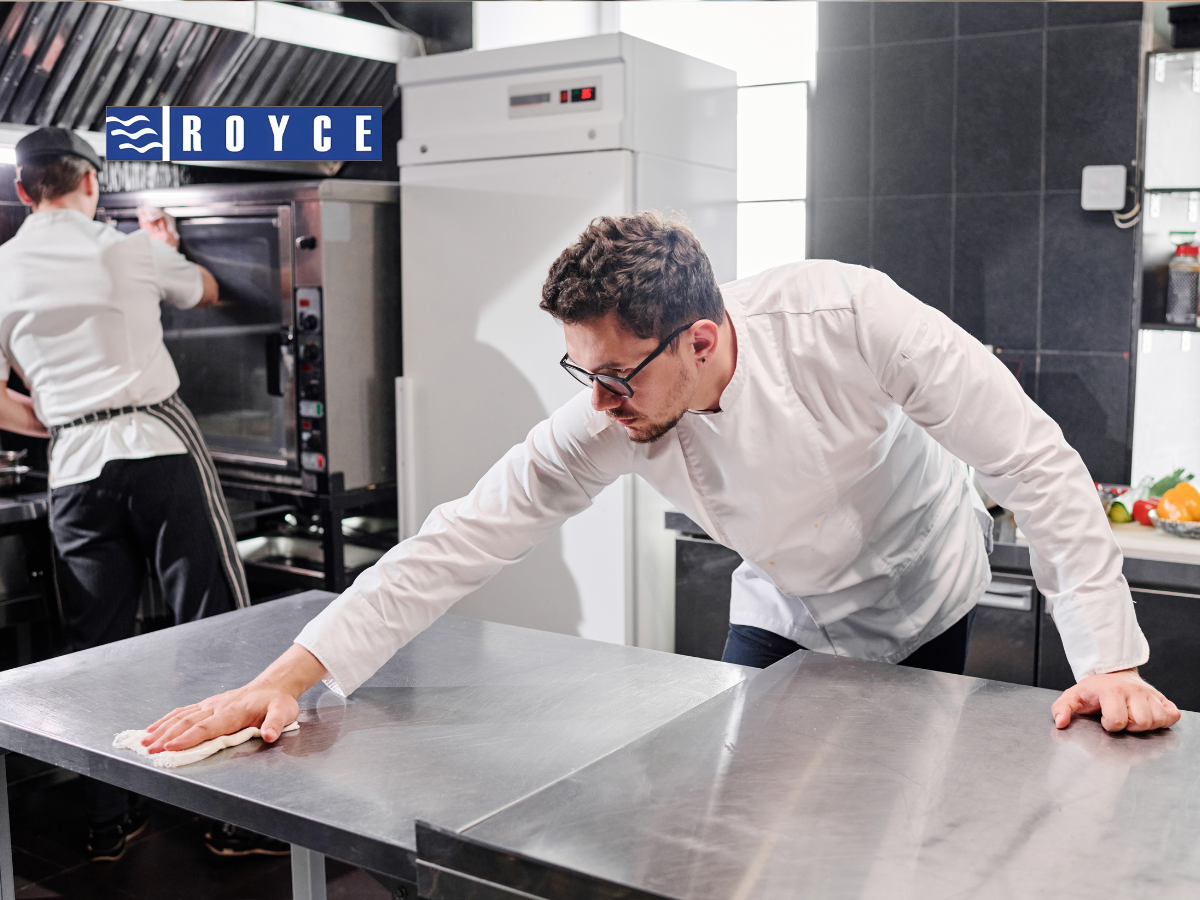
A commercial kitchen cleaning protocol in NSW starts from a legal baseline. Under the Food Standards Code, the premises, fixtures, fittings and equipment must be kept free of accumulated grease, food waste, dirt and other visible matter, and food contact surfaces must be clean and sanitary. A protocol that meets that standard has three layers: clean-as-you-go during service, a close-down clean at the end of every shift, and a periodical deep clean of the areas daily cleaning cannot reach, such as behind and under equipment, walls, canopy filters, floors and drains. Cleaning and sanitising are two separate steps, and both have to be done properly.
This guide is for restaurant and cafe owners, head chefs, venue and club managers, and anyone responsible for a commercial kitchen in Sydney. If you are looking after a staff kitchenette in an office, our office kitchen hygiene checklist is the better starting point.
What does the law require of a commercial kitchen’s cleaning?
Food businesses in NSW must comply with the Food Act 2003 (NSW) and the Australia New Zealand Food Standards Code. Local councils inspect most retail and food service businesses, and the NSW Food Authority oversees the system. Several parts of the Code bear directly on cleaning.
Standard 3.2.2 (Food Safety Practices and General Requirements) sets the core cleaning obligations:
- Clause 19 requires the premises to be maintained to a standard of cleanliness where there is no accumulation of garbage (except in garbage containers), recycled matter (except in containers), food waste, dirt, grease or other visible matter. Fixtures, fittings and equipment must be kept to the same standard.
- Clause 20 requires eating and drinking utensils to be clean and sanitary immediately before use, and food contact surfaces of equipment to be clean and sanitary whenever food that will come into contact with them is likely to be contaminated.
- Clause 21 requires the premises, fixtures, fittings and equipment to be kept in a good state of repair and working order.
- Clause 24 requires all practicable measures to be taken to prevent pests entering the premises and to eradicate and prevent harbourage of pests.
Standard 3.2.3 (Food Premises and Equipment) deals with design and construction, including that floors, walls, ceilings, fixtures and equipment can be effectively cleaned. It matters to a cleaning protocol because surfaces that cannot be cleaned properly will eventually fail clause 19.
Standard 3.2.2A (Food Safety Management Tools) has applied to most food service, catering and related retail businesses since 8 December 2023. Category one businesses (those that process potentially hazardous food into food that is ready to eat) must have a food safety supervisor, trained food handlers and the ability to substantiate their critical food safety controls. Category two businesses must have the first two. Food handler training must cover cleaning and sanitising of food premises and equipment. For category one businesses, cleaning and sanitising is one of the prescribed activities that must be substantiated, typically through records kept for at least three months, or by demonstrating the procedure to an authorised officer. Businesses licensed with the NSW Food Authority operate under their own food safety programs and Standard 3.2.2A does not apply to them.
The NSW Food Authority’s Standard 3.2.2A guidance has a short quiz to help you work out which category your business falls into.
What is the difference between cleaning and sanitising?
Cleaning removes visible matter: food residue, grease, dirt. Sanitising reduces microorganisms on a surface that is already clean, to a level that is safe. The order matters. A sanitiser applied to a dirty surface does not work properly, because the residue protects the microorganisms underneath it.
A typical process for a food contact surface is:
- Remove loose food and debris.
- Wash with detergent and warm water to remove grease and residue.
- Rinse to remove the detergent.
- Sanitise, using either a food-safe chemical sanitiser at the concentration and contact time on the label, or heat.
- Allow to air dry, or dry with a single-use cloth.
Many products combine detergent and sanitiser, but they still need a clean surface to work on and the correct contact time to be effective. Follow the label exactly. More product is not better, and a sanitiser wiped off too quickly may not have done its job.
What should a daily commercial kitchen cleaning protocol include?
During service
Clean-as-you-go is the habit that keeps a kitchen under control during service. Spills are wiped up as they happen, boards and utensils are swapped and washed when moving between raw and ready-to-eat food, benches are cleaned and sanitised between tasks, and waste is kept contained. It is the kitchen team’s job, because it cannot be separated from food preparation.
The close-down clean
At the end of each service or shift, the kitchen is reset. A close-down checklist usually covers:
- Food contact surfaces: benches, cutting boards, slicers, mixers and prep equipment cleaned and sanitised.
- Cooking equipment: cooktops, grills, fryers (as required by the oil change schedule), ovens and salamanders wiped down and degreased.
- Utensils, crockery and cookware: washed and sanitised, by hand or through the dishwasher.
- Sinks and hand basins: cleaned, with hand basins stocked with soap and paper towel.
- Handles and touch points: cool room and fridge handles, oven knobs, switches and taps.
- Floors: swept and mopped, including under benches that can be reached.
- Bins: emptied, with bin lids and surrounds cleaned.
- Drains and floor grates: debris removed.
A written checklist, signed off at the end of each shift, does two jobs. It makes sure the close-down is done the same way whoever is on, and it provides a record if your business needs to show how cleaning is managed.
What belongs in a periodical deep clean?
Some parts of a commercial kitchen cannot be cleaned properly in a close-down. They need time, access and often equipment to be moved. That is the work of the periodical deep clean.
- Behind and under equipment. Grease and food debris build up behind ranges, fryers and fridges. Equipment on castors should be moved out and the floor, walls and equipment sides cleaned.
- Walls, ceilings and light fittings. Grease and moisture settle on every surface in a busy kitchen, including above head height.
- Canopy and extraction filters. Filters that are not degreased regularly lose effectiveness and hold a build-up of grease that is a fire risk. Cleaning inside the exhaust ductwork is separate, specialist work usually tied to the building’s fire safety arrangements, so confirm who is responsible for it.
- Floors, grout and drains. A deep clean of floors, including machine scrubbing, and thorough cleaning of floor drains and grates.
- Cool rooms and freezers. Shelving, walls, floors and door seals, coordinated with stock rotation so the clean can be done without risking product.
- Dry stores. Shelves cleared and cleaned, and floors and corners checked for signs of pests.
- Dishwashing and wash-up areas. Machine exteriors, surrounds, splashbacks and the floor beneath.
How often each item is done depends on the kitchen’s volume and menu. A kitchen running fryers and grills every day will need more frequent canopy filter and wall cleaning than one producing mostly cold food. Set a frequency for each item, record when it is done, and adjust if inspections show it is not enough.
Who should do what: the kitchen team or a cleaning contractor?
Most kitchens use both. The kitchen team handles clean-as-you-go and food contact surfaces during and after service, because they are on site and trained in food handling. A cleaning contractor handles the deep cleaning, floors, walls, canopy filters and the work that suits the hours outside service, when the kitchen is empty and equipment can be moved.
Under the Food Standards Code, a food handler includes a person who handles surfaces likely to come into contact with food. That means contract cleaners working in your kitchen are subject to the same hygiene expectations as your staff while they are doing that work. Make sure they are inducted to your kitchen’s procedures, including where chemicals are stored, which cloths and equipment are used where, and how the kitchen should be left for the morning team.
How do chemicals, safety and food contamination fit together?
Cleaning chemicals are themselves a contamination risk in a kitchen. Products should be food-safe where they will be used on or near food contact surfaces, stored away from food and food packaging, clearly labelled, and used at the right dilution.
Cleaning chemicals are also covered by WHS. Under the Work Health and Safety Regulation 2017 (NSW), hazardous chemicals must have current Safety Data Sheets available and must be stored and handled correctly. Commercial kitchens add hazards of their own for cleaning staff: hot surfaces, hot oil, sharp blades on slicers and mixers, and wet floors. Equipment should be switched off, isolated where necessary and allowed to cool before it is cleaned, and the people cleaning it should know how.
How do pests and waste fit into a kitchen cleaning protocol?
Cleaning is the first line of pest prevention. Food residue under equipment, grease in floor drains and bins left open overnight are exactly what pests look for. Clause 24 of Standard 3.2.2 requires food businesses to take all practicable measures to keep pests out and to eradicate and prevent their harbourage, and good cleaning is most of the practical work. Where pests are already present, a planned commercial pest control program and the cleaning schedule should be coordinated, and our guide to cleaning up after a pest infestation covers what to do once treatment is complete.
Waste matters too. Bins should be lidded, emptied before they overflow, and washed regularly, and the waste area outside should be kept clean so it does not attract pests to the back door. A scheduled commercial waste removal service helps when volumes are high. Grease traps (grease arrestors) are serviced separately under your trade waste arrangements, so check those requirements with your water authority.
Hand washing facilities are part of the same picture. Hand basins must be stocked and accessible, and the supply of soap and paper towel is easy to manage through a hygiene services arrangement.
How does a cleaning protocol help at a council inspection?
Council environmental health officers inspect food premises against the Food Standards Code, and cleaning is one of the most visible things they assess. An inspection is not the time to discover that the area behind the fryers has not been touched in months.
A kitchen that follows a written protocol is in a much stronger position, for three reasons.
The hard-to-reach areas are already done. Inspectors look where daily cleaning does not reach: under and behind equipment, the tops of canopies, floor drains, cool room seals and the corners of dry stores. If the periodical program is running on schedule, those areas are already in order.
The kitchen can show how cleaning is managed. A cleaning schedule, signed close-down checklists and periodical clean records show that cleanliness is managed rather than left to chance. For category one businesses under Standard 3.2.2A, being able to substantiate cleaning and sanitising is a requirement in its own right.
Staff know the procedure. An inspector may ask a staff member how a bench is cleaned and sanitised, what sanitiser is used and at what concentration. A team that follows a written procedure every day can answer without hesitation.
If something is found, the same protocol is how it gets fixed and stays fixed. A one-off deep clean after an inspection deals with the immediate issue, and adjusting the frequency in the schedule stops it returning. Our article on how to prepare your workplace for health inspections covers the preparation side in more detail.
Frequently asked questions
How often should a commercial kitchen be deep cleaned?
There is no single frequency that suits every kitchen. It depends on the volume of food produced, the menu, the cooking methods and the condition of the premises. A busy kitchen using fryers and grills daily will need deep cleaning of filters, walls and floors more often than a kitchen producing mainly cold food. Set a frequency for each area, record when it is done and adjust if inspections show build-up between cleans.
Can a cleaning contractor clean the kitchen during service?
No. Deep cleaning involves moving equipment, wet floors and chemicals, none of which are compatible with food preparation. Contractor cleaning should be scheduled outside service hours, with the kitchen team handling clean-as-you-go during service.
Are contract cleaners considered food handlers?
Under the Food Standards Code, a food handler includes a person who handles surfaces likely to come into contact with food. Contract cleaners who clean food contact surfaces in your kitchen fall within that definition while doing that work, and should follow your kitchen’s hygiene procedures.
What records should a commercial kitchen keep about cleaning?
At a minimum, a cleaning schedule and signed checklists for the close-down and periodical cleans are good practice for any kitchen. If your business is a category one business under Standard 3.2.2A, you must be able to substantiate your cleaning and sanitising, which in practice usually means keeping records for at least three months.
Is a commercial kitchen clean different from an office kitchen clean?
Yes. An office kitchenette is a staff amenity, cleaned as part of general office cleaning. A commercial kitchen is a food premises subject to the Food Act 2003 (NSW) and the Food Standards Code, with grease, heavy equipment and food safety obligations that need a dedicated protocol.
Book a commercial kitchen deep clean
Royce Cleaning provides commercial kitchen cleaning across Sydney as part of our commercial cleaning services, scheduled outside your service hours. Request a quote and we will walk through your kitchen with you, look at the equipment, finishes and problem areas, and put together a deep cleaning scope that sits alongside your team’s daily routine.
Sources: Food Act 2003 (NSW); Australia New Zealand Food Standards Code, Standard 3.1.1 (Interpretation and Application), Standard 3.2.2 (Food Safety Practices and General Requirements, clauses 19, 20, 21 and 24), Standard 3.2.2A (Food Safety Management Tools) and Standard 3.2.3 (Food Premises and Equipment); Work Health and Safety Regulation 2017 (NSW); Food Standards Australia New Zealand, Safe Food Australia.