
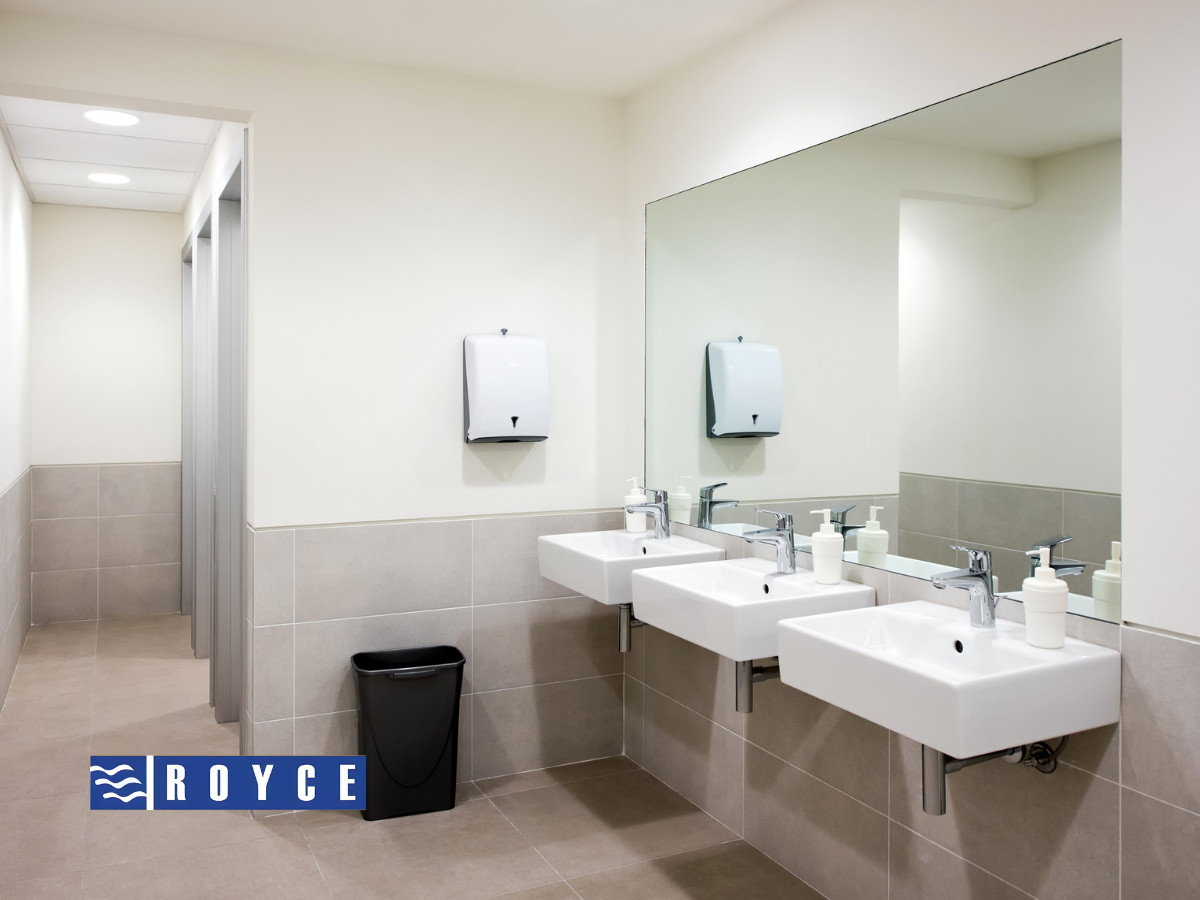
If you run a workplace in NSW, clause 41 of the Work Health and Safety Regulation 2017 requires you to ensure, so far as is reasonably practicable, that workers have adequate facilities including toilets, drinking water, washing facilities and eating facilities, and that those facilities are maintained so as to be in good working order, clean, safe and accessible.
That is the legal floor, and it is deliberately general. The detail sits in the approved NSW code of practice, Managing the work environment and facilities, which sets out how many toilets and hand basins you should have, what needs to be in them, and how often the whole lot needs cleaning and restocking. That code matters more than most facilities managers realise, and this article explains why.
| Free Site Assessment Royce Cleaning provides commercial cleaning and hygiene services across Sydney and New South Wales, with a site walk-through and a written scope of works supplied with every quote. Call 02 9897 2099. |
Why the code of practice carries more weight than guidance usually does
This is the part worth understanding before anything else.
Managing the work environment and facilities is an approved code of practice under section 274 of the Work Health and Safety Act 2011 (NSW). Approved codes are admissible in court proceedings under the WHS Act and Regulation. A court may treat a code as evidence of what is known about a hazard, a risk, a risk assessment or a risk control, and may rely on it when determining what was reasonably practicable in the circumstances. An inspector may also refer to an approved code when issuing an improvement or prohibition notice.
So while the code uses “should” for its recommendations rather than “must”, the practical position is that a workplace falling below the code needs to be able to explain how it is achieving an equivalent or higher standard by another method. “We did not know” is not that explanation.
Who actually holds this duty in a leased building?
More than one party, at the same time, which is where most confusion starts.
The tenant business is a person conducting a business or undertaking and holds the clause 41 duty for its workers. Separately, a person with management or control of a workplace must ensure under section 20 of the WHS Act, so far as is reasonably practicable, that the workplace and the means of entering and leaving it are without risks to health and safety. In a leased building that is typically the landlord, building owner or managing agent.
The code addresses this directly. It notes that a PCBU renting their workplace shares duties with the landlord or property manager, and that in these situations the duty holders must consult, cooperate and coordinate activities with each other so far as is reasonably practicable. It gives checking that there are arrangements in place for the proper maintenance of facilities such as toilets as a specific example of what that coordination covers.
| The practical consequence A tenant cannot discharge the duty by assuming the building manager has it covered, and a building manager cannot assume each tenant has it covered. If your washrooms are shared common amenities, someone needs to be able to say who is cleaning them, how often, and who restocks them. If nobody in the building can answer that quickly, that is the gap. |
How many toilets do you actually need?
For workplaces inside buildings, the National Construction Code sets the ratio of toilets to occupants and the specifications for them. The code of practice sets out the following as the minimum standard for workplaces generally.
A single unisex toilet may be provided where the total number of people who normally work at the workplace is 10 or fewer, and there are two or fewer workers of one gender. A workplace with two men and eight women, or one woman and three men, would qualify. A unisex toilet should include one closet pan, one washbasin and a means for disposing of sanitary items.
For all other workplaces, separate toilets should be provided in these ratios.
| Workers | Closet pans | Urinals |
| Males | 1 per 20 males | 1 per 25 males |
| Females | 1 per 15 females | Not applicable |
These are minimums. The code notes that the scheduling of workers’ breaks affects how many toilets are actually required, and that there should be enough available for the number of workers who may need to use them at the same time. A site where 60 people break simultaneously is not the same as a site where 60 people break in staggered shifts, even though the headcount is identical.
One more requirement that catches multi-level tenancies: in multistorey buildings, toilets should be located on at least every second floor.
How many hand basins?
In most cases, for both males and females, hand washing basins should be provided in at least the ratio of one basin for every 30 male workers and one for every 30 female workers, or part thereof.
That ratio goes up depending on the work. Where the work involves exposure to infectious substances or other contaminants, the code says separate hand washing basins should be provided in addition to those provided with the toilets. This is directly relevant to medical centres, childcare, food handling, aged care and any industrial process where workers handle contaminants, and it is a requirement that a general office fit-out benchmark will not satisfy.
What hand washing facilities should have
- Accessible at all times to work areas, eating areas and toilets.
- Separate from troughs or sinks used in the work process.
- Both hot and cold water taps, or temperature mixers.
- Protected from the weather.
- Non-irritating soap, preferably from a soap dispenser.
- Hygienic hand drying, for example automatic air dryers or paper towels.
Note the last two. Soap “preferably from a dispenser” and hand drying that does not involve workers sharing towels are both consumables questions, not fixture questions, which brings us to the item most workplaces actually fail on.
The consumables problem
The code is explicit that toilets should be supplied with toilet paper for each toilet, hand washing facilities, rubbish bins, and, for female workers, a hygienic means of disposing of sanitary items. Separately, in its section on monitoring and maintaining facilities, it states that consumable items including soap and toilet paper should be replenished regularly.
The self-audit checklist at Appendix B of the code turns this into questions a WorkSafe inspector could reasonably ask on a site visit:
- Are consumable items, such as soap and toilet paper, replaced regularly?
- Are facilities cleaned regularly?
- Are toilet paper, hand washing facilities and soap, rubbish bins and sanitary disposal bins provided?
- Is broken or damaged infrastructure, such as plumbing, air-conditioning or lighting, repaired promptly?
- Is hygienic hand drying provided that does not involve workers sharing towels?
An empty soap dispenser is not a housekeeping annoyance in this framework. It is a facility that is not in good working order. The distinction between a workplace that passes this and one that does not usually has nothing to do with the quality of the fit-out and everything to do with whether someone owns the restocking. Where consumables are left to whoever notices, they run out. Royce Cleaning provides hygiene services covering consumables and washroom servicing alongside general cleaning, which removes the “who was supposed to order that” problem entirely.
Sanitary disposal is a service, not a bin
The code requires a hygienic means of disposing of sanitary items in female and unisex toilets. A bin on its own does not meet that description for long. Sanitary waste needs scheduled exchange or servicing on a defined cycle, with the units maintained and the waste removed through an appropriate stream.
This is one of the most common gaps in small and medium workplaces, because a bin looks like it satisfies the requirement and nobody revisits it. It also sits awkwardly in shared-amenity buildings, where the tenant assumes the building manager arranges servicing and the building manager assumes the opposite. If your building has shared washrooms, this is worth confirming in writing rather than assuming.
What about eating areas and drinking water?
These sit inside the same clause 41 duty and are frequently overlooked in cleaning scopes.
| Requirement | What the code sets out |
| Drinking water | Clean drinking water must be provided free of charge at all times, positioned for easy access and separate from toilet or washing facilities to avoid contamination. The temperature should be at or below 24 degrees Celsius, and water should be supplied hygienically so workers do not drink from a shared container. |
| When a separate eating area is needed | A separate eating area should be provided if 10 or more workers usually eat at the workplace at the same time, or if there is a risk of substances or processes contaminating food. |
| Size of an eating area | Eating areas should have one square metre of clear space per person likely to use the area at any one time, calculated free of furniture, fittings and obstructions. |
| What it should contain | Tables and seating, a sink with hot and cold water, washing utensils and detergent, an appliance for boiling water, clean storage including a refrigerator, and vermin-proof rubbish bins. |
| Bin emptying | Vermin-proof rubbish bins in eating areas should be emptied at least daily. |
That last line is worth putting into a cleaning scope explicitly. Daily bin emptying in kitchen and eating areas is a stated expectation in an approved code of practice, and a cleaning schedule that attends three days a week without an arrangement for the other two has a gap someone should have named.
| A note on shared kitchens Where a cleaning contract attends less often than daily, the workable answer is usually a split: the contractor handles bins on attendance days, and the tenant nominates who empties them on non-attendance days. Royce Cleaning raises exactly this in the quoting process, because it is one of the things clients most often assume is included and most often is not. |
The five-minute audit you can run this week
Drawn from the checklist at Appendix B of the code. Walk your amenities and answer honestly.
- Count. How many workers normally on site, and how many closet pans and hand basins? Compare against the ratios above.
- Check every dispenser. Soap, toilet paper, hand drying. Any empty or near-empty unit is your answer about whether restocking is actually owned.
- Check sanitary disposal. Is there a unit in every female and unisex cubicle, and is it on a servicing cycle you can name?
- Check the drinking water. Accessible, clean, cool, separate from washing facilities, free of charge?
- Check the eating area. Enough clear space for the number who eat at once, and are the bins actually being emptied daily?
- Check accessibility. Can workers with a disability use the facilities, and can workers on every shift, including night shift, access them?
- Check the repairs. Any broken plumbing, lighting or ventilation outstanding, and how long has it been outstanding?
- Check the record. Can you show what was cleaned and restocked, and when? If not, you have no evidence of compliance, only an assertion.
One thing to ask your cleaning contractor about
The same code of practice contains a detail that says something about how a contractor runs its own operation.
In its guidance on remote or isolated work under clause 48 of the WHS Regulation, the code uses a cleaner working by themselves at night in a city office building as its example of a worker who may be isolated even though other people are nearby. It uses that same example again when discussing emergency plans. Commercial cleaning is very often after-hours, alone, in buildings with restricted access and poor mobile reception in basements and stairwells.
A contractor who has thought about this will have communication procedures, site inductions and reporting arrangements. It is a reasonable question to ask, and the answer tells you a lot about whether their compliance is systematic or aspirational. Royce Cleaning inducts staff to each site so they are familiar with that building’s security protocols and evacuation points, uses police checked staff who keep doors locked behind them when working outside business hours, and requires anything unusual found on site to be reported to supervisors.
Frequently asked questions
How many toilets does a workplace need in NSW?
The approved NSW code of practice sets the minimum standard as one closet pan per 20 males and one urinal per 25 males, and one closet pan per 15 females. A single unisex toilet may be used where 10 or fewer people normally work at the workplace and two or fewer are of one gender. For workplaces inside buildings the National Construction Code also sets ratios and specifications, and break scheduling can mean more are needed than the minimum ratio suggests.
Is the landlord or the tenant responsible for washroom cleaning?
Often both, at the same time. The tenant business holds a duty to provide adequate, clean and accessible facilities for its workers. A person with management or control of the workplace, typically the landlord or managing agent, holds a duty for the workplace itself. The WHS Act requires duty holders sharing a duty to consult, cooperate and coordinate, so the practical answer is that it needs to be agreed and documented rather than assumed.
Does the law require sanitary bins?
The code of practice states that toilets should be supplied with a hygienic means of disposing of sanitary items for female workers, and that a unisex toilet should include a means for disposing of sanitary items. A unit alone is not the whole requirement. It needs to be serviced on a cycle so that it remains hygienic.
How often do washrooms need to be cleaned?
The code does not set a universal frequency. It says facilities must be clean, safe, accessible and in good working order, and that workplaces and facilities should be cleaned regularly taking into account the type of work performed, the likelihood of contamination, the number of workers using them including during shiftwork, and the type of facility. In practice that means frequency is set from the site, which is why a walk-through matters more than a price per hour.
What happens if a WorkSafe inspector finds our facilities inadequate?
An inspector may refer to an approved code of practice when issuing an improvement or prohibition notice. In court proceedings a code is admissible and may be relied on in determining what was reasonably practicable. Compliance can be achieved by another method if it delivers an equivalent or higher standard, but the onus is on the business to be able to demonstrate that.
Make hygiene someone’s job instead of everyone’s assumption
Royce Cleaning provides commercial cleaning and hygiene services across Sydney and New South Wales, covering offices, warehouses, medical centres, schools, gyms and strata. A site walk-through and a written scope of works come with every quote, and the scope can be amended before you agree to it.
Call 02 9897 2099 or request a free quote online.